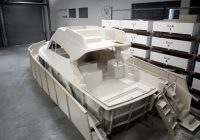
Grand Banks V-Warp Technology delivers an advantage in fuel efficiency that blows away the competition.
Many people familiar with Grand Banks have heard the term V-Warp Technology. But fewer people have an understanding of what that phrase actually means. In truth, it encompasses three distinct aspects of Grand Banks’s approach to building the most efficient motor yachts on Earth.
The three distinct prongs of V-Warp Technology are: Hull shape, construction materials, and construction techniques. Understanding each element provides a crystal-clear understanding of the Grand Banks difference and DNA.
Hull Form
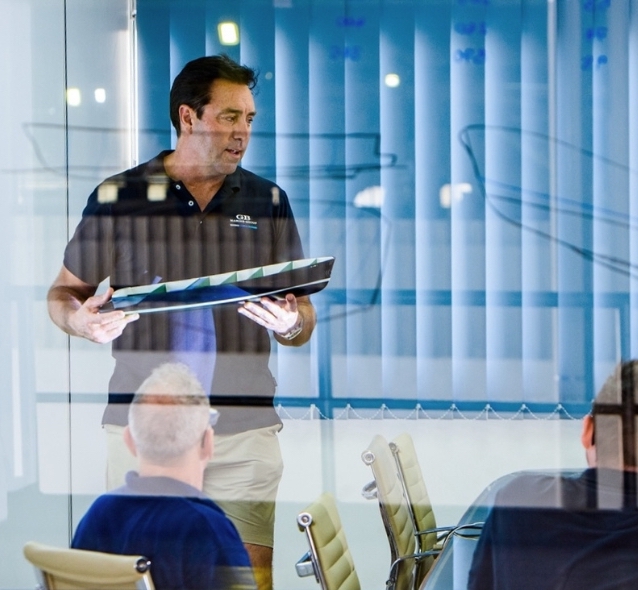
First things first, there is no other powerboat on the planet with a hull that can do what a Grand Banks hull does. CEO Mark Richards drew from his storied career as a competitive sailor to help create a slick bottom with some key differentiating points. For one, a fine entry helps the Grand Banks models slice through both calm seas and head seas with an efficiency and seaworthiness that won’t be beat. This design aspect makes Grand Banks yachts particularly adept at handling head seas, where they offer extremely soft rides. The hull is warped, and all the way aft it has just 6 degrees of transom dead rise. That hull shape also allows the boat to draw considerably less than a more traditional deep-V design. With less boat in the water, it takes significantly less energy and fuel to propel it along. One tell tale sign of this phenomenon on a Grand Banks is the wake. If you look behind you while underway on a Grand Banks boat, you will be shocked at just how small the boat’s wake actually is. And that’s a direct result of the minimal energy needed to keep the yacht underway.
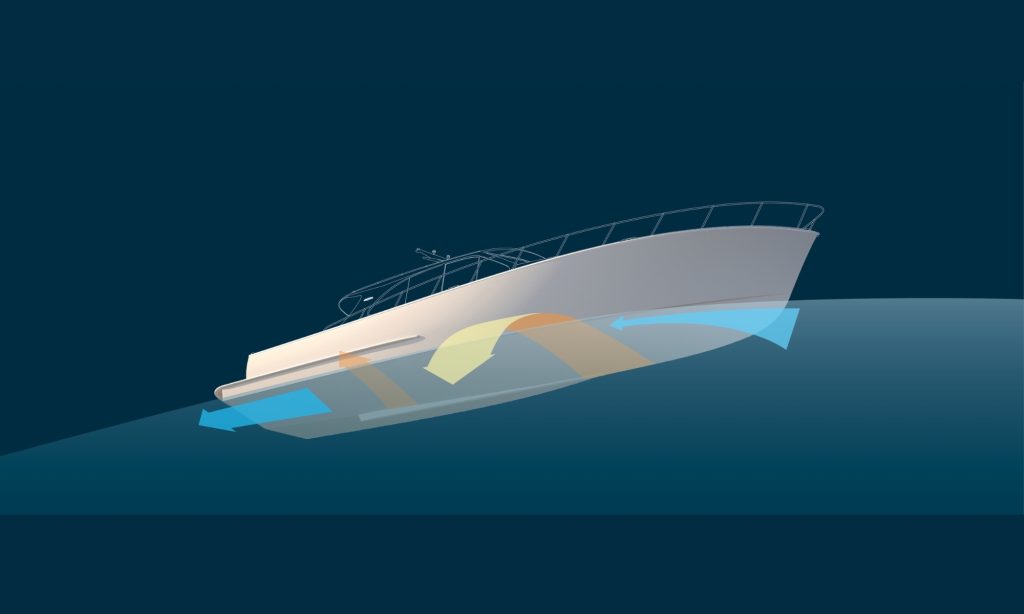
The flattened aft section of the hull has other advantages as well. For one, it helps the boat get up and onto plane quickly, and at lower speeds, than one might expect. Beyond that, at anchor, the boat is remarkably stable thanks to its wide, level base. And at speed, the faster you go, the more stable the boat becomes. This is in contrast to a deep-V, which may start to chine walk or fall to either side after reaching a certain velocity. It’s an effect that must be experienced to be fully understood.
Exotic Materials
The second aspect of V-Warp Technology is the materials Grand Banks uses to build its boats. All models make extensive use of carbon fiber, and it’s not just for style points like some boat builders use it. Instead, it’s all about performance. Each super structure is made entirely from carbon fiber, which makes the boats’ center of gravity very low, creating a seakeeping platform that is incredibly stable. Carbon fiber has the best weight-to-strength ratio of any boat building material. Not only does it help to keep Grand Banks boats’ COGs low, it also makes each yacht exceedingly strong, and super light—which of course adds even more fuel efficiency.
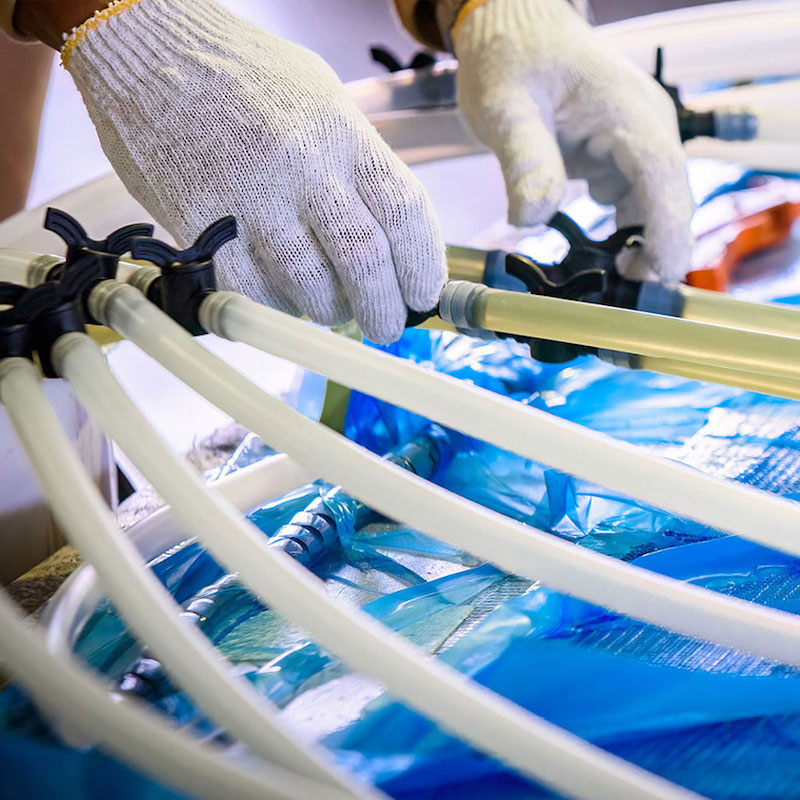
Grand Banks carbon fiber is pre-cut and unidirectionally designed. Having all the fibers running in the right direction amplifies the already resilient material’s strength by multitudes. Grand Banks boats are engineered by Gurit, one of the biggest and most well-respected composite engineering companies in the world, and they take good care to ensure all of the engineering details on the boats are done correctly.
Build Philosophy
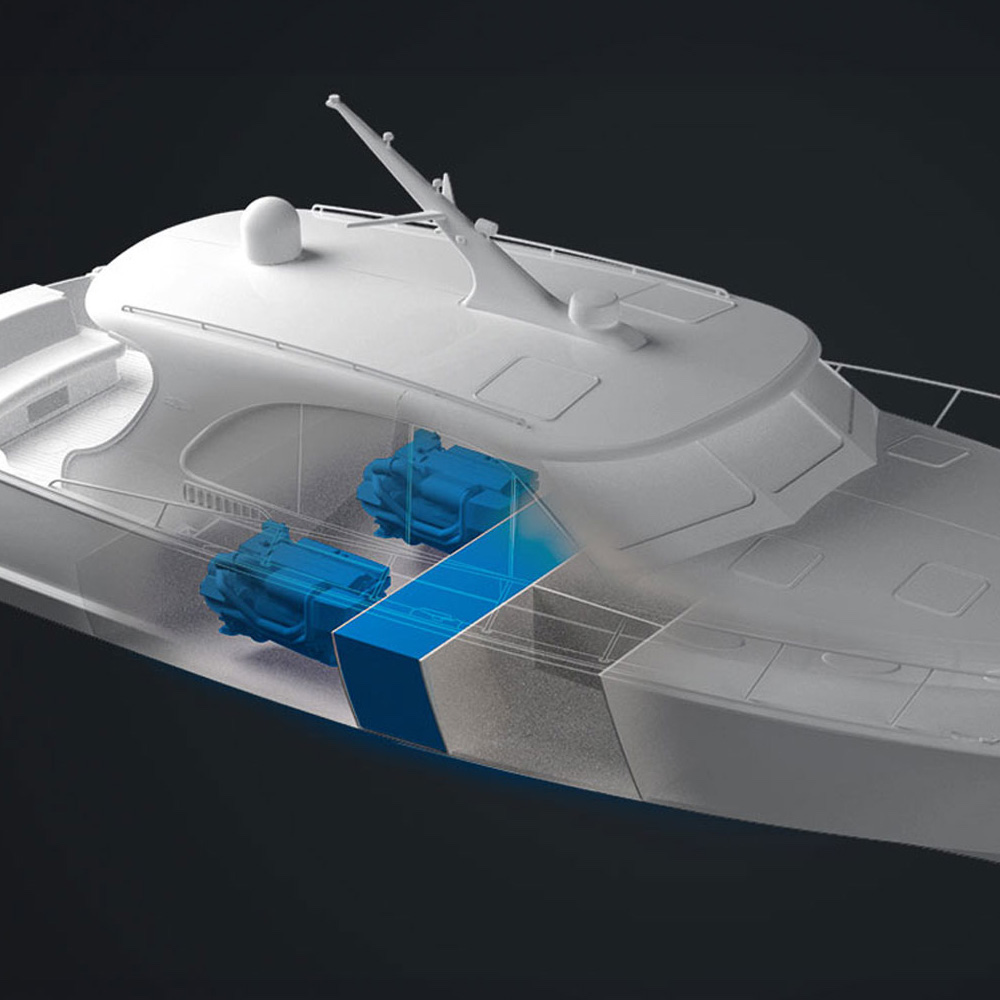
V-Warp Technology’s third element is construction technique. Whereas most boat builders in this size and class use plywood bulkheads, Grand Banks bulkheads are made from fully infused composites, just like a racing sailboat. Unlike the competition, which typically glues in these pieces on flanges, Grand Banks laminates them right into the hull. This monocoque construction technique makes the boats light and stiff and free from any creaks and groans—with the additional benefit of allowing a high level of customisability. The technique demands a slightly slower build time but makes the boats significantly stronger and more seaworthy. “The advantage that V-Warp Technology gives us,” says Richards, “is unlike anyone else’s in the history of powerboating.”
But you don’t have to take his word for it. Just have a peek at the performance numbers from one of Grand Banks most popular models. The Grand Banks 60 with Volvo D13 Shafts, for example, has a range of 761 nautical miles at 21 knots. There is no more fuel-efficient and cost-effective way to run a powerboat. Most boat owners would be shocked at how rare a trip to the fuel docks becomes when doing the Florida-to-Bahamas run aboard a Grand Banks.
For more information visit www.grandbanks.com