Volunteering is deeply woven into the fabric of Australian life. From rural fire brigades to surf lifesaving clubs, from the SES to Marine Rescue services nationally, the spirit of giving back without expectation of reward defines much of who we are as a nation. It’s an instinct that connects generations, a shared belief that community service is not only worthwhile but vital to our way of life.
Within this culture of service, it’s common to find families who volunteer together, each generation learning from the one before. What’s far less common, however, is to find a family that has maintained that commitment for as long, and with such distinction, as Ian and Peter Baker of Marine Rescue NSW.
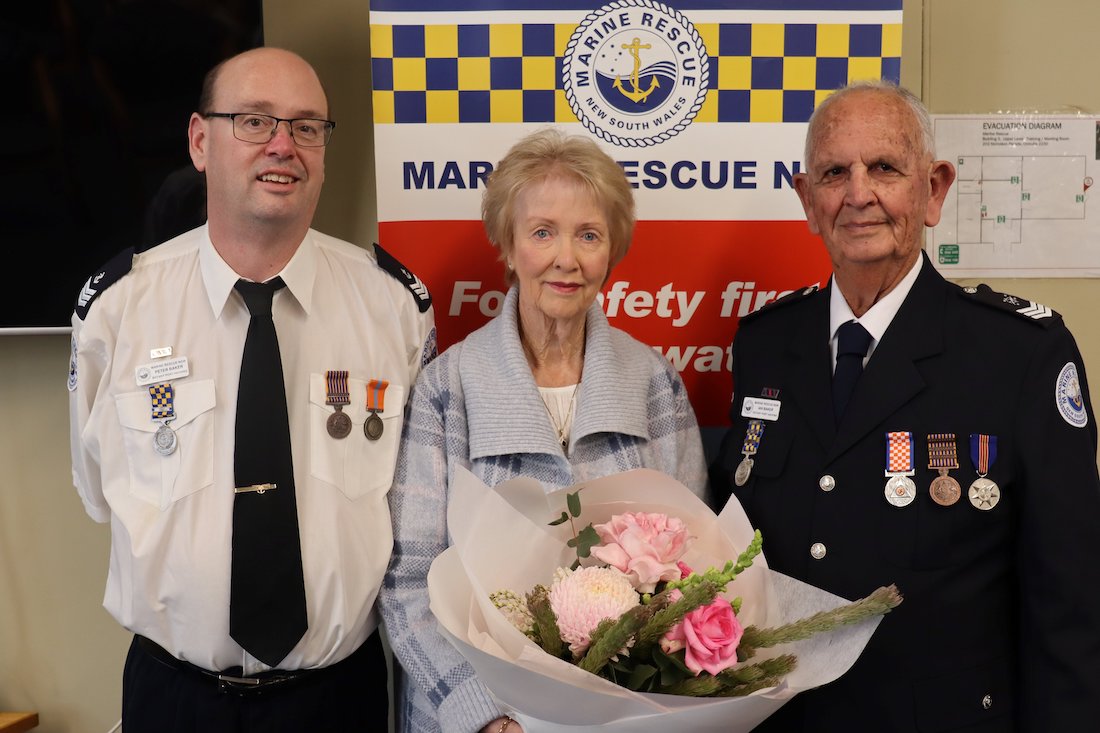
Ian Baker ESM with wife Dianne and son Peter (left) who has also volunteered with Marine Rescue Botany Port Hacking for 30 years
Between them, Ian and Peter have served a combined 80 years, Ian for an extraordinary 50 years, and his son Peter for 30 years. Their contribution represents thousands of volunteer hours, hundreds of rescues, countless training sessions, and immeasurable comfort to those in distress. Ian is a Life Member of Marine Rescue NSW and Peter is a Life Member of the Botany Port Hacking Unit of Marine Rescue NSW, respected mentors, and operational leaders who have guided others through both calm and crisis.
For Ian Baker, volunteering began in 1975 with the Australian Volunteer Coast Guard, decades before the formation of Marine Rescue NSW. His service record is remarkable, more than 400 rescues, many in dangerous and life-threatening conditions. Now in his eighties, Ian remains an active Coxswain and Search and Rescue Support Officer, continuing to serve the boating community with the same quiet professionalism that has defined his career. His leadership and mentorship have inspired generations of rescuers, and his dedication has been recognised with multiple honours, including the NSW Maritime Medal (2021) and the Emergency Services Medal (2024 King’s Birthday Honours). He still does Crew Operational assessments
His son Peter followed in his wake, joining the Australian Volunteer Coast Guard and then transitioning to Marine Rescue NSW and developing his own distinguished path as a Coxswain, Watch Officer, Trainer, and Assessor. Professionally, Peter is also a trainer and safety specialist, using his skills to educate both volunteers and the public in maritime operations, first aid, and emergency response. Like his father, he is driven by a simple philosophy, helping others, staying calm under pressure, and passing on knowledge that might one day save a life.
The Bakers represent the best of what volunteering stands for. Their decades of service demonstrate not just technical excellence, but humanity, compassion, resilience, and an unwavering sense of duty. They remind us that the act of volunteering is as much about what you give as what you gain: friendship, purpose, and the quiet satisfaction of knowing you’ve made a difference.
In this “In Conversation” feature, we speak with Ian and Peter Baker about their shared journey, their motivations, and what keeps them coming back to the water, year after year, decade after decade.
Marine Business News spoke to Ian and Peter, and this is what they had to say.
Ian said:
You’ve spent half a century saving lives on the water, what first inspired you to volunteer back in 1975, and what’s kept you motivated all these years?
I first joined the AVCGA to find out more about the best type of boat to buy for our families’ use. I ended up not buying a boat but got my salt water fix on other private boats and AVCGA corporate boats followed by MRNSW vessels. The more I learned the more difficult it became to make a selection for me.
After 50 years of service, what moments stand out most vividly, the rescues, the camaraderie, or perhaps the changes you’ve witnessed in boating safety?
Probably the best thing that stands out is the camaraderie that just evolves, it is not just a single event but a growing trust in each other and a support network that develops over time on and off the water and helping each other out in tougher times. For rescues the longest was one that took over 12 hours to find because he insisted he was in one place and his GPS said he was over 10 miles away. The most gruesome was two PWCs that collided head on over a wave with one driver sustaining a broken hip, broken jaw and severe lacerations to his face. The most stressful was a yachtsman who had been hit in the back by the bow spit of another yacht in a race, he was left hanging over the side yacht and not being able to move for about 45 minutes while the yacht was towed back to a wharf for medical intervention and treatment. I think the major changes have been made with the amalgamation of three volunteer rescue organisations into one and the improvements that has given the volunteers i.e. better and newer equipment, better and newer PPE and a much improved, formalised and more widely recognised training regime.
Marine Rescue NSW has evolved dramatically since the Coast Guard days. How do you see the organisation’s progress, and what remains at its core despite the change?
Marine Rescue NSW evolved from three very different historical backgrounds and had a few hiccups in the first few years. Volunteering has always been the main motivation of all members and the foundation of volunteerism remains strong.
You’ve trained and mentored so many volunteers, what qualities do you believe define a great Marine Rescue NSW member?
A willingness to listen to and learn from others as we teach and train a very specialised set of skills not normally found elsewhere in the maritime environment. You definitely need to be able to be part of a team and have your other crew members’ backs. You must also be comfortable in dealing with crew and boaters who are from a variety of backgrounds.
Having your son follow your path must be a proud moment. What has it meant to share this journey with Peter?
Initially it was just something that happened on a casual basis, but as time went on and his commitment to Coast Guard became more apparent and the skills that he learnt over the years eventually put him in a position to become a Professional Trainer in various aspects of Safety and Training. I could not be more proud of the way he has turned out and his attitude to helping others where ever he can.
Peter said:
Growing up with a father so committed to service, was volunteering with Marine Rescue NSW always something you felt drawn to, or did it happen naturally over time?
I think it was a bit of both. I always had a desire to be around the water and boats. As I grew this became a need to learn about boats and boating. In understanding the volunteer drive to learn and help I decided to join in and became a volunteer.
You’ve taken on many roles. Which aspects of the work give you the most fulfilment today?
The ability to assist members of the public who are in need of assistance is the most satisfying part of the role. It always has been. People are in trouble, usually it is something minor that has gone wrong, which has them stranded at sea. The ability to help those people and turn a potential disaster into a safe return is quite rewarding.
You’ve helped modernise training delivery within Marine Rescue NSW. How important is ongoing education and innovation in ensuring crew safety and capability?
It is extremely important. Ongoing training with measurable outcomes is highly important. However, it is no substitute for experience. Transitioning to a competency-based system means people’s abilities and experience are taken into account. While learning a skill like navigation can be done in a classroom, it is not until that knowledge is implemented at sea that the student truly understands why it is needed and important.
Balancing a professional life in safety and training with volunteer responsibilities is demanding. How do you maintain that balance?
This has not always been easy to do. Luckily, I currently have an understanding employer who allows good flexibility in my hours. I have also had to limit the amount of time I can dedicate to volunteering. I often have to miss meetings and some other events, particularly during the week, as I have to work. However, the group is very supportive and provide me with the necessary updates and information.
You’ve spent three decades volunteering, what have you personally gained from the experience?
In volunteering you meet all manner of people from all walks of life with different skills and abilities. Learning from those people using their individual skills to solve problems and adapt to different situations. I also try to pass on my knowledge of how to do certain things, thereby building their skills and knowledge. Those interactions help make us all better people. Taking those skills into the greater world is a benefit to everyone.
When you look at your father’s 50 years of service, what lessons or values has he passed on that continue to guide you in your own volunteering journey?
By volunteering, in anything, you are helping the community. We do not volunteer for recognition or reward. It is done to help others. Sometimes you meet people who become lifelong friends. Sometimes it is a safe space to talk about your problems. Volunteering requires commitment, dedication and sacrifice but can also be rewarding and welcoming.
You’ve mentored many new members through their first training sessions. What message would you share with people, especially younger Australians, who might assume Marine Rescue NSW is only for retirees? How can volunteering in the Service enrich their lives and careers, no matter their age or background?
Younger people often struggle with volunteering. They are often use to a more structured training environment. In schools, universities and most jobs people are scheduled to attend training. They are told what to do and pushed through the process. Marine Rescue NSW is a little different. We want the people to step forward and ask for the things they need. If they feel weak in an area of knowledge, they tell us and we guide them through it.
The normal training for most places is to impart knowledge to the student. At Marine Rescue NSW we also want to develop self-confidence and self-belief. Having the knowledge is only part of it. Having the confidence in their abilities and skills, to take that knowledge and use it in a situation where lives are on the line, without hesitation, is a life skill that all people should have.
For younger people to have that confidence and belief will support them throughout their lives. It also develops their ability to advocate for themselves in everyday life in a constructive and appropriate way. It may outwardly appear that Marine Rescue NSW is full of older people, but, those older people are there to help. To share their knowledge, and their experiences with others. For anyone, coming to Marine Rescue NSW who is willing to talk, listen and absorb those experiences and knowledge they will grow beyond what they thought they were capped at.
Marine Rescue NSW is a volunteer based not-for-profit professional organisation dedicated to keeping boaters safe on the water and supporting local communities.