By Christophe Saune, Group Growth Director, Wearth Group
Why marina operators worldwide are treating environmental performance as core engineering, not an afterthought.
Christophe Saune, Group Growth Director, Wearth Group
The marina industry doesn’t need another lecture on climate urgency, it needs a clear-eyed look at what’s actually being built, tested and proven in ports and marinas around the world. This article walks through different areas of marina life cycle where meaningful change is already underway: design and construction decisions that cut carbon footprint and protect the seabed; management practices and certifications that turn good intentions into measurable results; on-water technologies tackling pollution and rebuilding biodiversity at the source; and the increasingly important question of what happens to a marina’s infrastructure once its life ends. The throughline isn’t sacrifice — it’s better engineering.
To better place environmental initiatives in today’s context, it’s worth first highlighting the pressures marinas are currently facing on a sustainability front and understand why the environment is now a boardroom issue.
POLITICAL – Coastal and marine policy is tightening almost everywhere marina operators operate, from EU water framework directives to Australian state-level biodiversity offset schemes. Port authorities increasingly tie concession renewals and expansion approvals to demonstrated public benefit and environmental performance, not just safety and capacity, which is starting to drive construction norms and standards.
ECONOMIC – Water restrictions, hydrocarbon liability, and end-of-life disposal costs are shifting from externalities to line items. A marina that still relies on potable water for hull washing, or faces demolition costs for non-recyclable infrastructure, is carrying a cost its competitors are already engineering away.
SOCIAL – Marinas carry a reputational weight beyond their own clientele. For a public that rarely sets foot on a dock, marinas are seen as enclaves of private wealth occupying public coastline, and that perception shapes how willingly local communities, councils and regulators grant them room to operate and expand. It feeds directly into planning objections, tighter permit conditions and slower approvals. Visible environmental stewardship — clean water, thriving marine life, transparent practices — is how the industry earns its social licence to operate from people who will never own a boat but will always live with the coastline’s health.
TECHNOLOGICAL – What was once prohibitively expensive is now commercially mature and widely available at marina project scale, rather than niche innovation – which makes environmental initiatives something people and users increasingly expect.
ENVIRONMENTAL – Marinas sit at the exact interface climate change is reshaping fastest: sea level rise, storm frequency and intensity, freshwater scarcity, and biodiversity loss in coastal habitats. This isn’t a potential threat; it’s the physical operating environment of every marina worldwide.
LEGAL – Liability for pollution incidents, combined with the polluter-pays principle, is pushing responsibility frameworks for marine infrastructure in the same direction — proactive environmental design is becoming the cheaper legal position, not the costlier one.
Taken together, these six forces don’t just encourage environmental investment in marinas — they’re beginning to make it a condition for staying commercially viable and insurable over the long term. With that in mind, here’s a look at initiatives worldwide that are developed to encourage sustainable practices.
DESIGN AND CONSTRUCTION INITIATIVES
For decades, marina construction has followed a simple logic: build it strong, build it once. But strength alone no longer meets the brief. Markets are evolving faster than ever, and resilience in marinas now depends on the ability to react to that change. Modularity solves that problem; reconfigurable dock systems that can be resized, relocated, or reassembled as a marina’s berth mix evolves avoids the wholesale demolition and rebuild forced by fixed solutions. The environmental case is straightforward: less waste generated, fewer embodied carbon emissions locked into structures that may only last a 10–15-year redevelopment cycle.
Anchoring systems are being challenged in similar ways, with piling drawing criticism in a growing number of locations over its lack of flexibility, the carbon footprint of steel pile production, and the seabed habitat disturbance caused by pile driving. Underwater, anchoring is having its own quiet revolution; elastic mooring systems, Sweden’s Seaflex and New Zealand’s Marine Flex, are now widely used across sensitive coastal environments. Marine Flex’s systems have been deployed in a seagrass restoration program at Shoal Bay, NSW – proof that mooring hardware can support habitat recovery rather than work against it.
The materials conversation is shifting too. Docking systems using recycled and bio-sourced content — such as Poralu Marine’s Harmony finish, built from recycled aluminium, polyethylene, and expanded polystyrene, with rice-husk composite decking — cut a dock structure’s carbon footprint by 64% compared with conventional materials, without compromising the structural integrity throughout its working life cycle.
MARINA MANAGEMENT PRACTICES: TURNING INTENTIONS INTO STANDARDS
Freshwater scarcity is becoming a genuine operational risk for marinas, particularly in regions facing seasonal restrictions. Boat washing and hull cleaning traditionally consume large volumes of fresh water – a resource increasingly rationed by local authorities during dry periods, sometimes forcing careening areas to scale back a large share of their activity.
Desalination-based cleaning stations, such as Monawa “Ecostation” system, address this directly: seawater is desalinated on-site and used for washdown and hull cleaning, dramatically cutting freshwater consumption. Installations in several French ports have increased available washing capacity with no additional environmental cost, simply by using an abundant local resource instead of a scarce one.
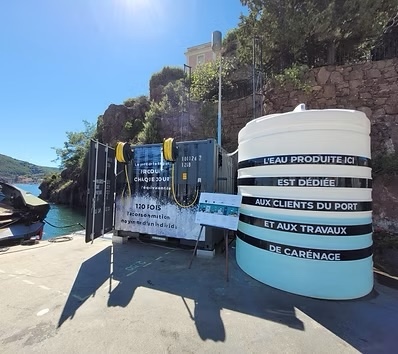
Ecostation Monawa. Source: monawa.fr
Alongside the hardware sits a management question: how does an operator know which practices actually matter? Certification frameworks help answer that. The Marina Industries Association’s (MIA) International Clean Marina Program and Europe’s Ports Propres scheme both formalise best practices across stormwater control, spill prevention, waste handling and biodiversity, turning intentions into auditable standards. The result, reported across certified marinas on both sides of the world, is measurable: reduced exposure to fines, documented water quality improvement, and — in several French cases — the visible return of flora and fauna to previously degraded water basins.
WASTE AND BIODIVERSITY: STOPPING POLLUTION AT THE SOURCE
Fuel and oil leaks during refuelling remain one of the most persistent and cumulative low-grade pollution sources in marinas. Conventional floating booms and other absorption techniques are deployed, where possible, but often with a reaction time too slow to control the full spread. At Port of Saint-Tropez’s Phare Vert fuelling station in France, the Searial Cleaners installed the InvisiBubble: a submerged, perforated pipe generating a continuous column of air bubbles from seabed to surface, forming an invisible barrier that contains hydrocarbons at the point of leakage, without obstructing boat traffic – turning pollution response from a reactive clean-up into an immediate, on-site containment. It echoes a principle Australia’s Seabin helped popularise years earlier: intercepting debris and hydrocarbons at the source, inside the marina, rather than downstream or in the ocean.
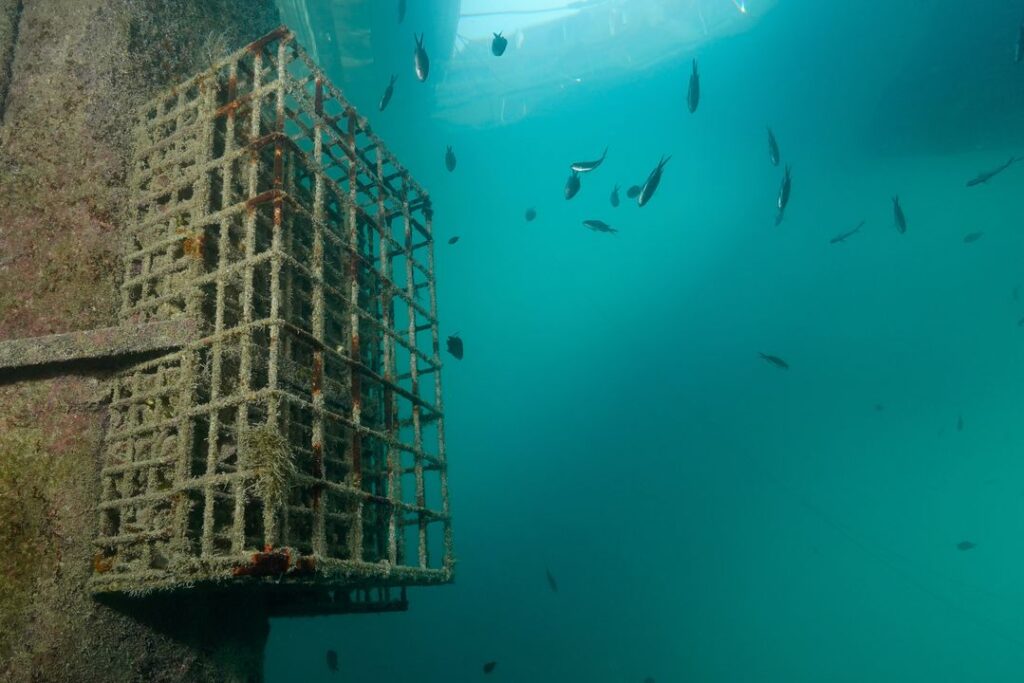
Ecocean Pylon Biohuts®. Source: Ecocean website
Habitat is the other half of the equation. Living Seawalls, developed in Sydney Harbour and now installed worldwide, retrofit textured panels onto flat seawalls and pilings that mimic rockpools and crevices; monitored sites show markedly higher species counts than bare infrastructure of the same age. France’s Ecocean has pursued a parallel path with Biohuts®: small, submerged nursery structures installed beneath floating docks that shelter juvenile fish. Both point to the same insight: hard infrastructure doesn’t have to be a biologically dead space.
END OF LIFE: DESIGNING FOR WHAT COMES AFTER
The environmental cost of a marina is rarely settled at construction – it’s settled decades later, at demolition. Composite and mixed-material structures are impossible to separate, sending tonnes of material to landfill when a facility is finally decommissioned, a significant issue given the growing reach of the polluter-pays principle.
Eco-design approaches increasingly favour products that make material separation at end of life. Mono-material, easily recyclable components, modular fixings rather than bonded joints, and decking that can be unbolted rather than demolished all help turn infrastructure into a potential source of revenue rather than a waste problem. It becomes a design discipline where the same modularity that eases mid-life reconfiguration also simplifies eventual disassembly and material recovery.
None of what is described here requires marinas to choose between profitability and sustainability, between performance and environmental responsibility – they are increasingly becoming part of the same decision. Low-carbon construction, seabed protection, water-saving initiatives and pollution-containment systems are no longer pilot projects; they are embedded into marina development and management processes. The operators moving first won’t just be greener, they’ll be better positioned commercially, operationally and reputationally for decades ahead. Tomorrow’s marina isn’t a compromise between financial viability and biodiversity, the solutions exist, and it comes down to today’s choices.
This story was reproduced from Waterline Magazine with permission from Marina Industries Association.