Marine habitat maps are an important and useful tool for understanding and managing our oceans, including the Lord Howe Island Marine Park (LHIMP).
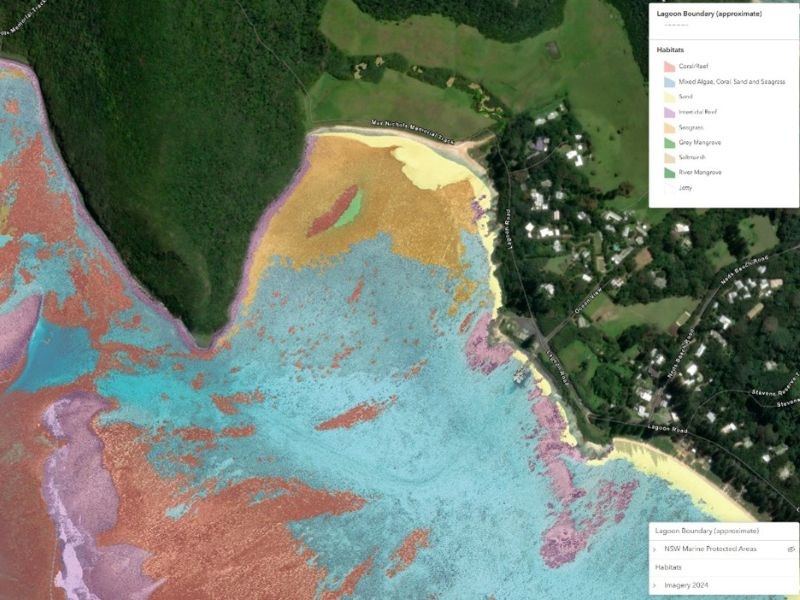
The LHIMP is internationally significant and includes the Lord Howe Island lagoon, formed by the world’s southernmost coral reef.
The sheltered lagoon has a globally unique mix of habitats, including coral gardens, seaweed reefs, seagrass beds, deep sand holes and rocky shores. These habitats support diverse tropical, subtropical and temperate marine species, including many endemic to the area.
Researchers have published marine habitat maps of the Lord Howe Island lagoon since the 1970’s. The earliest maps were hand-drawn using aerial photographs and snorkel or dive surveys. New technologies, including high-resolution cameras, drones and artificial intelligence, now allow us to map these habitats with greater precision and accuracy.
This new habitat map is based on high-resolution, low-altitude aircraft imagery captured in 2023. It was funded by NSW Department of Primary Industries and Regional Development (DPIRD) and the Lord Howe Island Board. NSW DPIRD staff identified key habitat types in the lagoon, which were then automatically classified at a resolution of 30cm using Object Based Image Analysis and Convolutional Neural Networks.
These techniques use artificial intelligence trained to interpret imagery based on pixel appearance, recurring patterns and textures across multiple pixels. This was followed by additional manual checking, classification and cleaning of map features.
This habitat map will be a useful tool for research, monitoring and planning. It can be used, for example, to measure the area of different habitats, identify appropriate locations for a range of activities, and assess changes or impacts to habitats.
Additional mapping of key areas within the lagoon is also ongoing using drones in collaboration with Southern Cross University. This work supplements the whole-of-lagoon habitat map by providing rapid and cost-effective means of mapping smaller, targeted areas at regular intervals.
These maps are being used to assess coral bleaching impacts and recovery from the 2019 and 2024 marine heatwaves. The researchers have developed methods to automatically and accurately distinguish between healthy and bleached coral at a scale of centimetres. One of the key challenges has been training artificial intelligence to distinguish between bleached coral and image pixels which appear white due to sun glint on the water surface.
These drone maps can also be used to monitor other important ecological trends such as coral mortality from low-tide aerial exposure and changes in seaweed growth.
For more information, visit www.marine.nsw.gov.au