“The fish are here! The fish are here!”
The chant went up as Tim Perrin and Adam Chapman stepped into the classroom carrying a new aquarium and its first occupants – a tankful of small, brightly coloured native fish.
Tim wasn’t offended to be outshone by his tiny marine friends – in fact this was exactly the reception he’d hoped for.
Tim’s always loved fish – he got his first aquarium at age eight. Next to him, Adam had his own tanks from age 10. Neither could have imagined that their childhood hobby would carry them into careers at CSIRO, Australia’s national science agency.
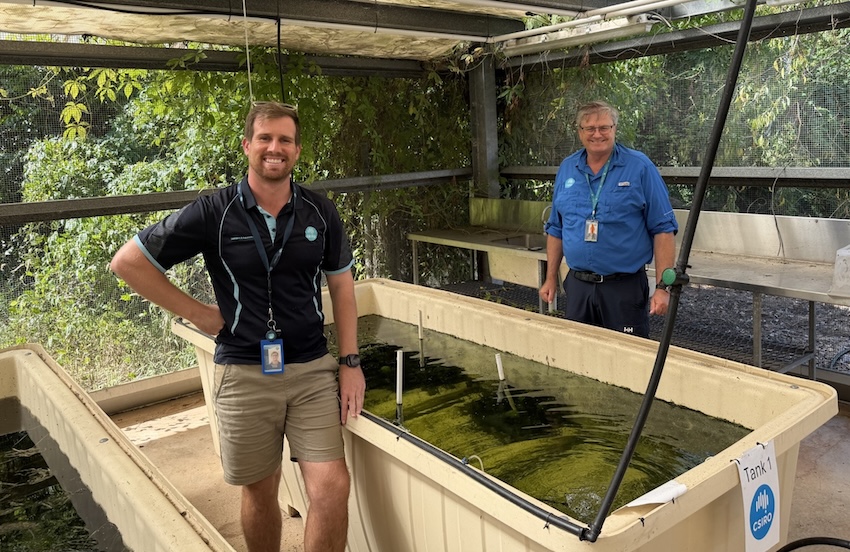
Tim Perrin (left) and Adam Chapman at CSIRO’s Berrimah site in Darwin, where most of the native plants that go into the classroom tanks are grown.
Now they’re betting the fascination that hooked them as boys might also inspire a generation of Northern Territory (NT) students.
Why a fish tank?
Over the last three years, Tim and Adam have been quietly piloting a new initiative called Aquariums in Schools. It’s a hands-on program designed to bring native fish into NT classrooms and aquaculture into the national curriculum.

Students at Dripstone Middle School with their classroom aquarium, now a regular fixture of their Year 7 and Year 8 science learning.
Each school receives a 182-litre tank, stocked with 20–30 NT-native ornamental species such as rainbowfish and Pacific blue-eyes, along with local plants – most of them grown by Tim and Adam at CSIRO’s Darwin site. Teachers also receive ready-made lessons keyed to their year-level curriculum.
“It can be as simple as that, particularly if the teacher isn’t necessarily experienced with fish themselves. Or they can take the next step which is a 10-week program where we really set up the fish tank and take a more in-depth look at aquaculture as a whole,” said Adam.
Adam and Tim have been travelling to remote schools in places like Groote Eylandt in the Gulf of Carpentaria around 630 kilometres east of Darwin.
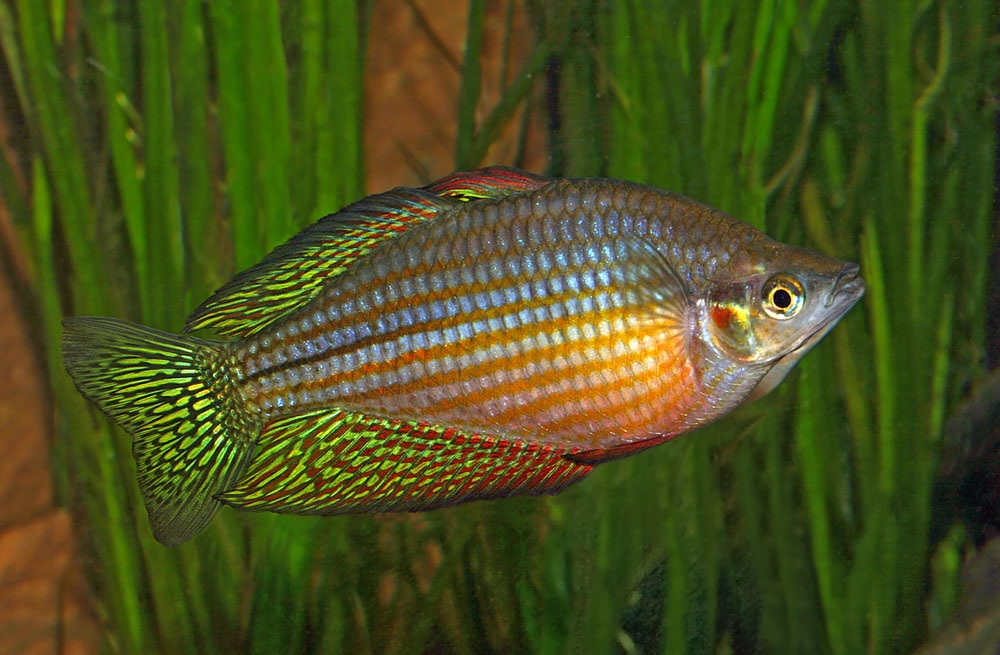
A Chequered Rainbowfish, native to the Mary River in the Northern Territory – one of the species featured in classroom tanks under the Aquariums in Schools program.
“We’re working with a local breeder, and our goal when visiting places like Groote Eylandt is to collect and culture local fish species, so that kids can say ‘this fish came from our river’,” Adam adds.
The two scientists hope that this early exposure will build a sense of environmental stewardship in the children and explore the value in what’s around them. As the course develops, children might be taught aquaponics, which draws more heavily on science and explores topics in biology and chemistry.
“The kids can get a much more in-depth look at production, and hopefully by the end of the term or the year, they’ve actually got excess fish which they can either take to the local aquarium store or take home themselves, and they’re hooked,” said Tim.
“There’s been a huge amount of interest from the children and teachers in this, and that’s really the draw. We imagine you could use the tanks as a teaching tool all the way from preschool up to Year 12, slowly teaching more technical aspects of aquaculture.”
So far, it’s been a hit – with six tanks already delivered across Darwin, three others in schools on Groote Eylandt and more on the way.
From curiosity to connection
“We never did a call-out. The program has grown organically through word of mouth,” said Tim.
“We’ve had over 20 schools in the NT reach out asking to be involved – but at the moment, it’s just the two of us managing everything.”
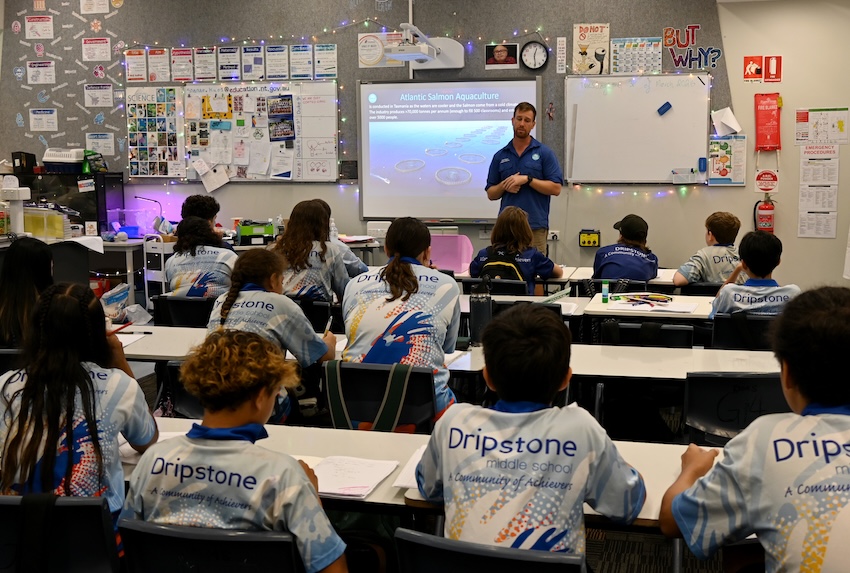
Tim Perrin teaching a Dripstone Middle School class – industry case studies like Atlantic Salmon aquaculture sit alongside the hands-on tank work in the program’s curriculum.
Teachers have reported high engagement and unexpected learning moments.
“Communication with teachers is really important to us. We know they have so much on their plates, and we are trying to present this in a way that it doesn’t add anything to their workload, making sure that the information is there for them,” Tim emphasised.
At one school, a teacher who’d been wary of taking on a tank changed her mind watching her students jostle for the chance to release the fish into the water. At Dripstone Middle School, in the north Darwin suburb of Tiwi, a Year 7 class sent handwritten feedback – generous on the whole, with a few notes for improvement.
“They said the PowerPoints were too long,” Tim laughed. “That’s a fair call.”
Angela Gahan, a teacher at nearby Moil School, saw the difference in both staff and students.
“The students enjoyed the fish, often coming into the classroom to feed, watch, check up on them and count the snails. Some teachers came to watch the fish for relaxation,” she said, adding that it was especially useful for their English as an Additional Language or Dialect (EAL/D) students who learn well with visual aids.
For Naomi, a Year 8 student at Dripstone Middle School, the tank made the science click.
“I loved looking after the fish tank because it made science feel real. Learning about the Nitrogen Cycle while actually testing the water and seeing how the fish responded has helped me understand it so much better,” Naomi said.
“It was exciting to know we were doing the same things that real scientists and fish farmers do.”
What’s clear is that the engagement is real – and for many of these students, it might be the start of something more.
Inspiring the next generation of aquaculture experts
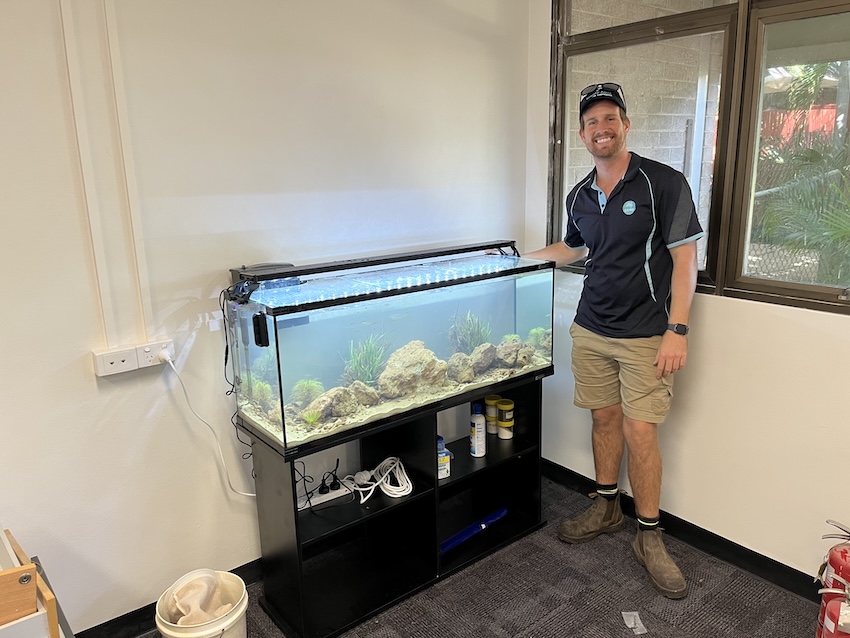
Tim with one of the 182-litre tanks supplied to a remote school on Groote Eylandt, ready for students to take over.
The answer lies in what Adam recognises as the enduring fascination many in the aquaculture industry trace back to childhood. The idea for the program took shape after both men heard from NT companies struggling to recruit skilled labour.
“They were all saying they couldn’t find staff, and that they struggled to get young people into the industry. We thought the solution might be getting kids involved really young,” said Adam.
“There’s a lot of potential for aquaculture on Country,” said Adam. “But you need that feeder system – the kids coming through who want to be part of it. That starts with connection and curiosity.”
While the program is already in demand, capacity remains the biggest challenge. This means for now the program isn’t taking on new schools. So far, much of the work has been done in Tim and Adam’s spare time, with limited funding. They’re now hoping to secure support to build video guides and training materials that will empower teachers to run the tanks more independently – especially as the team expands into remote schools.
On Groote Eylandt local interest in aquaculture is growing as the community plans for life beyond mining. Tim and Adam see this as a test case – can a classroom tank lay the groundwork for aquaculture enterprises on Country?
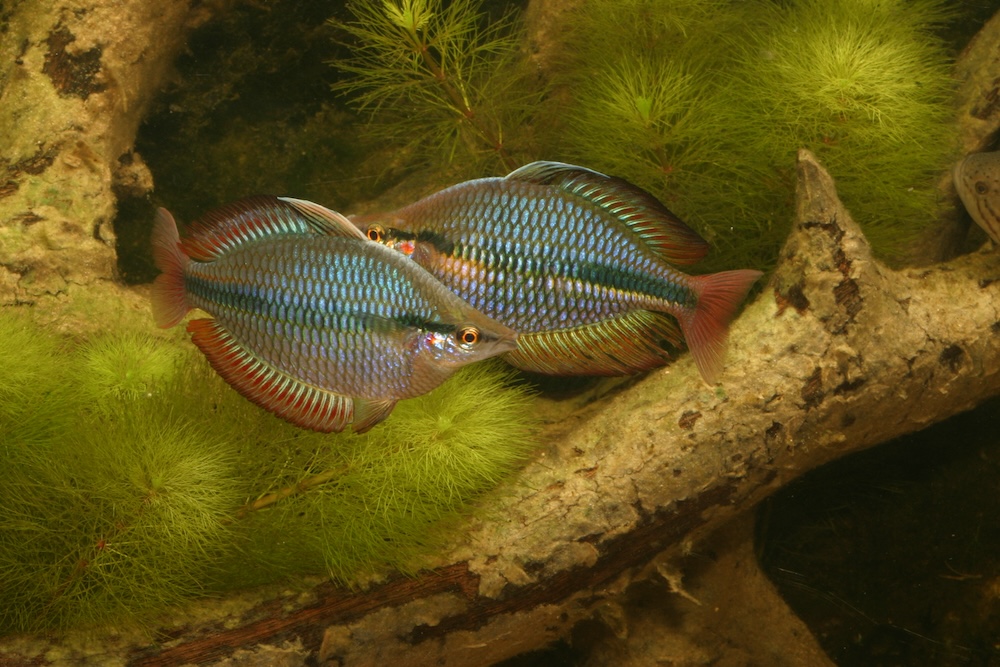
Goyder River Rainbowfish – another NT-native ornamental species that’s caught the eye of students in participating schools.
“We’d love to see more aquaculture on Country, which is something we’re trying to support.”
Communities that have access to land, paired with connections to the sea or river systems could greatly benefit from this. Internationally, there’s growing demand for native ornamental species. It’s a viable option to work on and with Country to sustain communities, said Adam.
“The long-term vision is to go Territory-wide, and eventually national,” said Tim. “Because this isn’t just about fish – it’s about science, sustainability, and opportunity. And all it takes to start is an aquarium in a classroom.”
This article is republished from CSIRO under a Creative Commons license.