Carbon monoxide (CO) poisoning remains one of the most dangerous, and least visible, safety risks in recreational boating. Every year, around the world, serious injuries and fatalities occur on boats of all sizes due to carbon monoxide exposure, often without warning, and frequently in situations where owners and crew believe they are safe.
Unlike many marine hazards, carbon monoxide gives no visual cues. It is colourless, odourless and tasteless, making it impossible to detect without specialised equipment. In confined or poorly ventilated spaces, it can accumulate rapidly, incapacitating people within minutes.
For marine businesses, service technicians, dealers and industry professionals, carbon monoxide safety is not only a personal concern but also a shared responsibility to educate and protect boat owners.
What is carbon monoxide and why is it so dangerous?
Carbon monoxide is a toxic gas produced by the incomplete combustion of fuel. On boats, it is generated by:
- Petrol and diesel engines
- Generators
- Fuel-burning heaters
- Gas appliances and cooktops
When inhaled, carbon monoxide displaces oxygen in the bloodstream. This starves vital organs, particularly the brain and heart, of oxygen. Early symptoms can include headache, dizziness, nausea and confusion. At higher concentrations, loss of consciousness and death can occur quickly, sometimes before victims realise anything is wrong.
Alcohol, fatigue and dehydration, all common factors in boating environments, can accelerate the effects and mask early warning signs.
How carbon monoxide builds up on boats
Carbon monoxide incidents on boats often occur during otherwise routine activities, including at anchor or alongside.
Common risk scenarios include:
- Running engines or generators while stationary
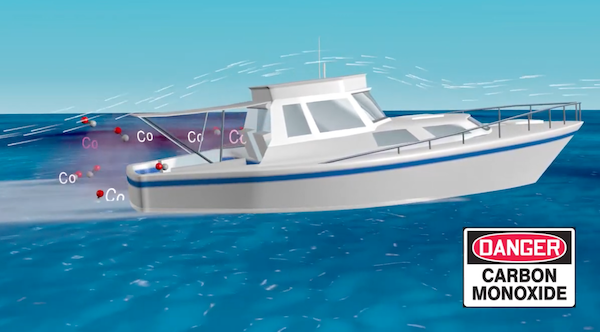
Exhaust gases can be drawn back into cabins or cockpits, particularly in calm conditions or when wind direction is unfavourable. - Enclosed or semi-enclosed spaces
Cabins, hardtops, clears, camper covers and enclosed cockpits can trap exhaust gases, especially when ventilation is limited. - Rafting up with other vessels
Exhaust from neighbouring boats can enter your vessel, even if your own engines are off. - Swimming or sitting near the stern
Exhaust outlets are often located near swim platforms. People in the water or seated at the transom can be exposed to high concentrations. - Poor exhaust system maintenance
Leaks, corrosion, blockages or modifications to exhaust systems can redirect gases into living spaces.
Why the risk is often underestimated
Many boaters associate carbon monoxide poisoning with old engines or poor maintenance. In reality, CO incidents occur on modern vessels, including well-maintained boats with compliant engines.
Factors that increase risk include:
- Calm weather with minimal airflow
- Following seas or stern-to wind conditions
- Extended idling or generator use
- Use of clears or covers to “keep warm”
- Sleeping aboard with systems running
Carbon monoxide does not dissipate as quickly as many assume, and lethal concentrations can build up faster than expected.
Practical steps to reduce the risk
Carbon monoxide poisoning is preventable. The following measures significantly reduce exposure risk:
Install marine-rated carbon monoxide detectors
- Fit CO detectors in all sleeping areas and enclosed cabins
- Use units designed for marine environments
- Test regularly and replace batteries as recommended
Maintain engines and exhaust systems
- Service engines and generators to manufacturer specifications
- Inspect exhaust hoses, clamps and outlets for leaks or corrosion
- Never modify exhaust systems without professional advice
Manage ventilation carefully
- Ensure adequate airflow when engines or generators are running
- Avoid sealing cabins or cockpits while machinery is operating
- Be cautious using clears, awnings and camper covers
Be aware of operating conditions
- Monitor wind direction and sea state when stationary
- Shut down engines or generators if exhaust fumes are detected
- Avoid running generators overnight unless necessary
Keep people away from exhaust outlets
- Do not allow swimming or sitting near the stern while engines or generators are running
- Educate passengers, particularly children, about stern exhaust hazards
Understand symptoms and act immediately
- Treat headaches, dizziness or nausea seriously
- Get everyone into fresh air immediately if CO exposure is suspected
- Seek medical attention promptly, do not “wait it out”
A shared responsibility across the industry
Carbon monoxide safety is not just a skipper’s issue. Dealers, manufacturers, service centres and workshops, marinas and charter operators all play a role in reducing incidents through education, design, maintenance and clear communication.
For boat owners, awareness is the first line of defence. For the industry, consistent messaging and practical guidance can save lives.
Carbon monoxide may be invisible, but its consequences are not. Taking simple, proactive steps ensures time on the water remains enjoyable, and safe, for everyone on board.
Those requiring additional information should contact their state maritime. In NSW information can be found HERE, in Victoria HERE, in Queensland HERE. Search “Carbon Monoxide” for other states.
Detectors are available through numerous boating outlets and on-line.