Managing fatigue: a safety priority
Fatigue is a hazard in domestic commercial vessel (DCV) operations and it can impact everyone on board, from the master to crew members — and passengers in the event of an incident. It must be managed like any other hazard within the vessel’s safety management system (SMS).
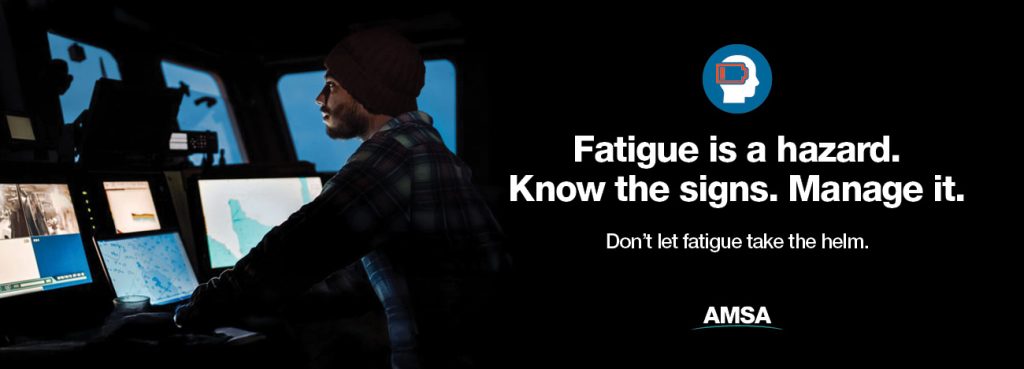
Fatigue management works best when crew are involved
Owners of Class 1, 2, and 3 DCVs are required to address fatigue risks in their SMS by:
- identifying when and why crew may become fatigued
- documenting how those risks will be controlled in a fatigue risk management plan.
Crew should be actively involved in planning, as they often notice early signs of fatigue. Their input is essential for creating practical and effective control measures.
Steps to manage fatigue
- understand fatigue
- manage fatigue risks through proper planning
- implement
- monitor
- review
Resources
- Guidelines for a SMS (including fatigue requirements)
- How to write a fatigue risk management plan (PDF)
- Scenarios and examples of fatigue risk management plans
- Fatigue risk management checklist (PDF)
- Questions and answers
Upcoming AMSA webinar: fatigue management on DCVs
Date: Wednesday 6 May 2026
Time: 2:30–3:15pm AEST
Online via MS Teams (you will receive the link closer to the event)

The next webinar explores:
- causes of fatigue
- recognising fatigue
- managing fatigue
- who is responsible for managing fatigue
AMSA’s experts will join the Q&A session.
Safety sounds good: listen to the latest audio brief
It’s now easier than ever for owners and operators to stay informed on key safety information. Whether you’re at sea or on the move, you can now access maritime safety updates in a convenient on-the-go format.

Audio briefs are now available to listen to on the AMSA website and through all major podcast platforms. Each audio brief delivers practical insights on key safety topics, including:
- managing operational stability risks in commercial fishing
- hazardous gases on domestic commercial vessels (DCVs)
Staying informed shouldn’t slow you down. Download an audio brief today and keep safety knowledge at your fingertips wherever your work takes you.
Safety lesson: stability issues contribute to trawler capsize
Vessel instability is a serious safety concern that can result in loss of control and capsize.
In one marine incident, a fishing trawler capsized in calm waters close to shore after changes to loading reduced the vessel’s stability. The master suffered a head injury, and pollution-control measures were required following the incident.
AMSA’s latest safety lesson examines key findings from this investigation and shows that stability risks often arise from changes to loading, fuel levels or deck equipment, free-surface effects, and modifications made without reassessing stability. Even minor changes can significantly affect a vessel’s behaviour.
Key safety lessons for vessel owners and masters:
- maintain your vessel’s stability as set out in the stability book
- identify risks to vessel stability in your safety management system
- keep records of vessel modifications that may impact stability
Learn practical actions you can take to reduce your capsize risk.
Marine incident report: October — December 2025
There were 344 reported marine incidents — 54 serious and 3 very serious — involving domestic commercial vessels in Quarter 4 of 2025, representing a 30% increase in total reported incidents compared to the previous quarter.
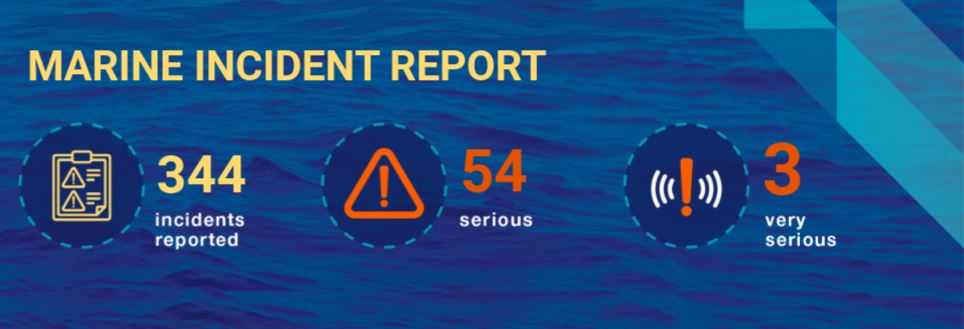
Snapshot of marine incidents last quarter:
A vessel sustained hull damage and flooded while moored on a rock bar, with five crew on board evacuating to the nearby shore and activating an EPIRB to seek rescue (very serious incident).
A vessel sank following engine failure, with all crew rescued from the life raft without injury (very serious incident).
Charging batteries began smoking and caught fire. The operator inhaled smoke while trying to extinguish the fire and was taken to hospital after firefighters extinguished the blaze.
A passenger tripped on a raised doorway threshold (door combing) and struck their head on a handrail, resulting in a serious head injury that required medical evacuation.
A master fell asleep at the helm near a harbour entrance, resulting in the vessel making contact with the seabed before returning to its berth without damage or injury.
In an emergency, there’s no time to improvise. A strong safety management system and practised crew training are what you rely on.
Read the marine incident report
Improving maritime safety — here’s how
- add procedures for emergency situations to your safety management system
- carry the right EPIRB for your operations
- reduce the risk of electrical faults and fires
- check your vessel complies with work health and safety laws
- develop a fatigue risk management plan
Operational monitoring: safety procedures in action
Ensure your vessel is ready to demonstrate key safety procedures during operational monitoring exercises.
Why it matters
Demonstrating your safety management system (SMS) in action during an inspection helps ensure your crew can respond effectively in an emergency. Identifying gaps during the exercise gives you the chance to improve procedures and keep passengers and crew safer on board.
AMSA conduct domestic commercial vessel operational monitoring exercises year-round across Australia, and will notify operators in advance to support participation and preparedness.
More information
Additional guidance is available in AMSA’s letter to the master on operational monitoring and SMS expectations.
Keep your lifejackets in working order
Lifejackets must be properly maintained to perform when they’re needed most. Regular checks and correct storage help ensure lifejackets remain reliable and compliant on board your domestic commercial vessel.
All lifejackets should be maintained in line with the manufacturer’s instructions and checked as part of your vessel’s routine safety processes.
In Australia, lifejacket maintenance generally includes 3 key areas:
Routine visual checks — before use, inspect lifejackets for damage, worn straps, broken buckles or faded labels. Any lifejacket showing signs of deterioration should be removed from service.
Inflatable lifejacket servicing — manual and automatic inflatable lifejackets require extra care. Check gas cylinders, inflation mechanisms and indicators regularly, and follow servicing schedules set by the manufacturer.
Correct storage — store lifejackets in a dry, accessible place away from sunlight, chemicals and sharp objects to prevent premature damage.
Well maintained lifejackets save lives. Make sure yours are ready for use — and that everyone on board knows how to check and wear them.
Stay safe with lifejacket maintenance
Your maritime safety toolkit — managing stability
Even small changes to your fishing vessel can affect stability. Make stability part of your safety planning.
Access the free guidance and resources designed to help you manage stability risks:
- stability risk assessment record
- vessel modifications
- fishing vessel stability checklist (PDF)
- hook-up response for trawlers
- guide to fishing vessel stability (PDF)
More resources from the recent AMSA webinar on vessel stability:
- watch the webinar recording
- listen to the audio brief
- download the presentation slides (PDF)
- answers to industry questions about stability (PDF)