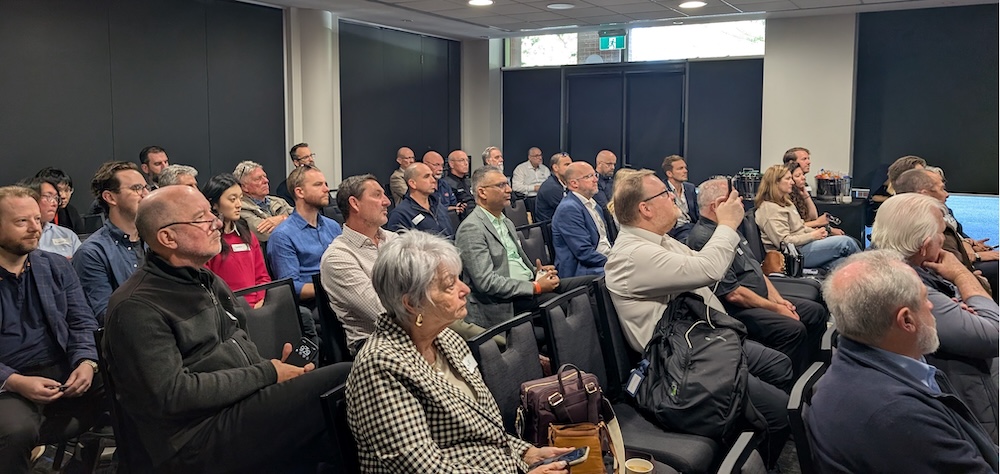
What should an electric vessel look like? Where will it charge? And who will have the skills to operate it? Those questions brought a broad cross-section of the marine industry together for MERC’s Discover Maritime Futures conference at Sydney Showground on Friday 18 September.
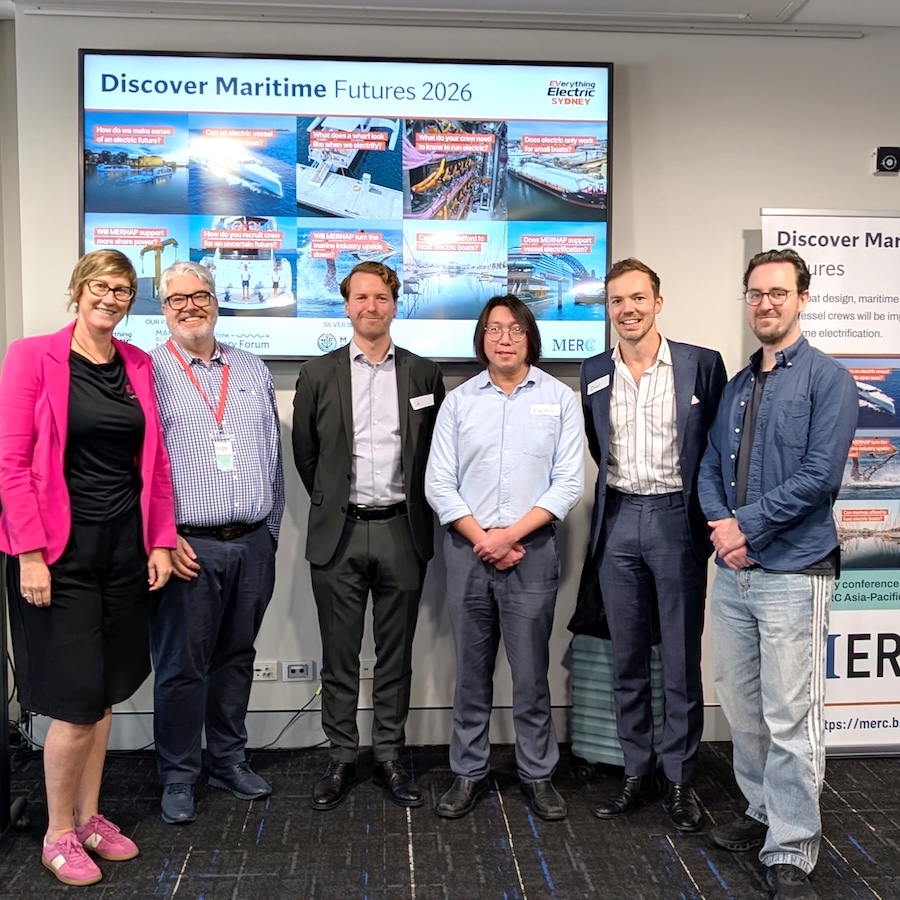
The room included people from recreational boating, but commercial marine interests were more prominent, with the shipping industry also represented. That balance was reflected in a program built around three connected themes: future boats, future wharves and future crew.
Angus McDonald, CEO and Chair of MERC Asia-Pacific, hosted the half-day conference. MERC Director Dr Camille Goodman delivered the Acknowledgement of Country before Augustus Yip, from the Australian Government’s Maritime Emissions Section, addressed delegates on the recently released Maritime Emissions Reduction National Action Plan. Yip’s work spans initiatives including international emissions negotiations and green shipping corridors, placing the day’s discussion within a wider policy effort to reduce maritime emissions.
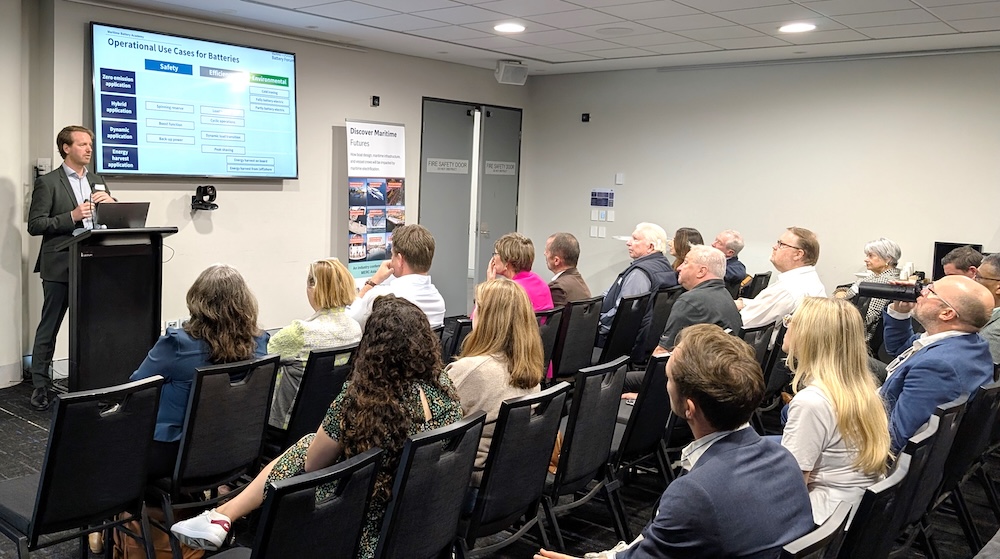
The keynote came from Syb ten Cate Hoedemaker, Managing Director of the Netherlands-based Maritime Battery Forum. His slides drew on the Forum’s ship register, which listed 2,104 battery-powered vessels globally, including 1,635 in operation. The figures demonstrated that maritime batteries are already in use at scale, while his comparisons of battery capacity and vessel length made another point clear: different ships need different battery systems.
That theme carried into the Future Boats panel. Paul Bury, presented in the program as Director of Bury Design, argued that the route and the job should determine the boat. His examples ranged from a slow, short-hop harbour catamaran to a vessel intended for longer, more exposed journeys. A slide comparing the energy carried by diesel and batteries illustrated the weight challenge designers face. For Bury, the availability of charging at one or both ends of a route could also determine whether a fully electric or hybrid vessel made sense.
Fiona Bycroft, CEO of Naut, set out a practical test for an electric boat: can it be built, can it do the job, and can it meet the budget? Her slides showed how hull resistance, operating speed and running time must be balanced against battery capacity and charging capability. Predictable routes, a return to base, high use and access to charging were among the conditions she identified as favourable for electrification. She also showed the ProtectorE 310 powered by Naut as an example of a familiar boat adapted for electric propulsion.
Mattijs Willenborg, CEO of Fibre Boats, approached design through the passenger experience. His electric hydrofoil presentation described the appeal of travelling with little engine noise, vibration or wake. Foiling can greatly reduce energy use at speed, he explained, but it suits particular journeys and conditions. Weight, take-off power, sea state, regulation and crew training all place limits on where the approach works.
Taken together, the boat presentations resisted the idea of a single answer. Some vessels and routes are well suited to electrification; for others, current battery weight, range or charging arrangements make it impractical. The emerging boats shown during the session also suggested a market in which purpose-built and bespoke designs are reaching early adopters before a standard solution exists for every use.
After morning tea, the Future Wharves panel turned to the part of the system that passengers may never see. Oliver Davey of Arup described charging infrastructure as an “upstream” challenge. His slides identified grid capacity, land at the berth and the time needed to secure both as factors that can decide whether a route can be electrified. His message was that vessel and shoreside planning have to move together.
Liz Yeaman, Managing Director for Australia and New Zealand at charging standards organisation CharIN, focused on interoperability. Her presentation showed electric craft ranging from recreational vessels to ferries and a tug using standardised charging systems. Common standards, she argued, allow different vessels and port users to share infrastructure while reducing reliance on proprietary equipment.
Voltron Dwyer, Head of Impact at Hullbot, completed the panel, bringing a marine technology perspective to the wharf discussion. Across the session, charging emerged as a design decision from the outset, rather than an addition to be solved after a vessel is built.
The final Future Crew panel brought ten Cate Hoedemaker back to the stage alongside Adam Chanter, Director of Marine Futures. Ten Cate Hoedemaker’s slides identified a gap between rules governing battery system design and installation and the operational requirements and training crews need. The training topics he outlined included battery management systems, charging and discharging, safety procedures, maintenance and emergency response.
Chanter widened the discussion to recruitment and workforce development. His presentation mapped the marine and maritime occupations facing skills shortages and called for stronger connections between employers, education, training and prospective workers. New technology will require new skills, but businesses must also be able to find and retain the people who will use them.
One of the most compelling opportunities discussed during the day was marine tourism. A quiet vessel with less vibration and wake can offer visitors a markedly different experience, as well as an environmental story. Yet the presentations showed why that opportunity must be assessed against each operation’s route, passengers, conditions, charging access and commercial realities.
The lasting impression from Discover Maritime Futures was one of practical ambition. Battery technology is advancing, and established marine businesses as well as newer designers are exploring purpose-built vessels. The work now is to match each boat to its purpose, provide the infrastructure it needs and prepare the people who will make it operate safely.
For more information about MERC and the work they do, visit their website HERE