Vessev, which designs and builds commercially-certified electric hydrofoiling vessels, has announced it will trial its VS–9 on Queenstown’s Lake Wakatipu as part of a broader exploration into sustainable urban mobility.
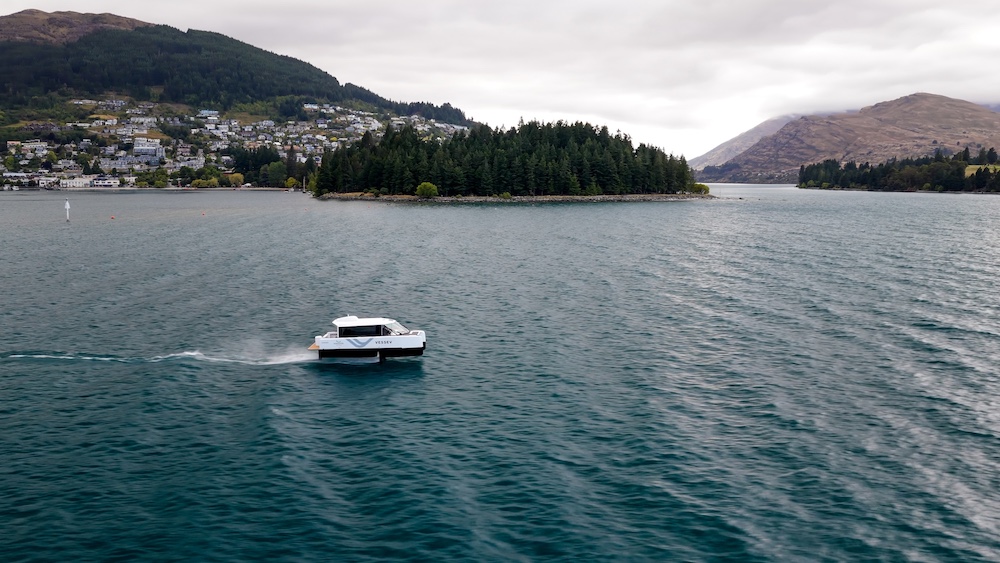
Queenstown, New Zealand’s fastest-growing city, has an ambition to become the world’s first fully electrified city. With a rapidly growing local economy and increasing tourism demands, the city faces transport challenges that are increasingly familiar to destinations around the world.
The trial, led by residential developer Kingston Village in partnership with Vessev and regional stakeholders, will run on February 10, with the aim to explore how future hydrofoiling passenger connections between Queenstown and Kingston could operate, looking at things such as travel times, passenger experience and specific operational factors relevant to the lake which will help form a wider feasibility study, planned for later this year.
Vessev CEO and Co-Founder Eric Laakmann believes Queenstown’s global profile and growth make it a compelling location for future-proof transport solutions.
“Queenstown is growing, and with that comes congestion and longer commute times,” Laakmann said. “Road expansion around Lake Wakatipu is constrained, but the lake itself presents an opportunity. At the moment it’s underutilized for transport, and electric hydrofoiling gives us a practical way to change that. By lifting vessels above the water, it becomes possible to deliver fast, comfortable services that can operate in a wider range of conditions. This trial will prove that electric hydrofoiling is the perfect solution for other busy waterways all around the world.”
Kingston Village General Manager Nicola Tristram said the ferry trial reflects a focus on planning for long-term livability as the Kingston community grows. Kingston Village, owned by the Goodman Family, represents a new phase of growth for the township of Kingston on the shores of Lake Whakatipu in Queenstown. It officially launched a year ago, selling 120 lots in record time.
“This trial will provide valuable insight into how lake transport could complement existing road and bus networks as well as the proposed cable car network for residents, commuters, and visitors,” Tristram said. “As the technology continues to evolve, the potential exists for future ferries on Lake Wakatipu to carry more passengers at a time, and this work will help ground those possibilities in real-world testing.”
The trial will use the VS–9, Vessev’s flagship passenger vessel and one of only two commercially-certified electric hydrofoiling vessels in operation worldwide. The VS–9 has been in commercial service for over a year, providing a proven platform for sustainable, high-performance electric water transport.
The VS–9 is a 29-foot electric hydrofoiling catamaran with carbon fiber foils that deliver a smooth, quiet, low-wake ride. With a cruise speed of 25 knots and range of up to 50 nautical miles, the VS–9 consumes up to 90% less energy than a traditional vessel of a similar size.
VS–9 Specs:
Cruise speed: 25 knots
Top speed: 30 knots
Range (at cruise): up to 40 nautical miles full load / 50 NM light load
Seakeeping: up to 2-feet 6-inches / 0.75m waves
Capacity: up to 10 passengers
Length: 29-feet 5-inches / 8.95m
Beam: 10-feet 2-inches / 3.1m
Draft: 1-foot 8-inches / 0.5m – 4-feet 11-inches / 1.5m
Hull: carbon fiber composite
Battery capacity: 105 kWh
Charge rate: up to 1.25 NM/min
Charging (DC): up to 150 kW
Charging (AC): up to 22 kW
Propulsion: 100% battery electric from Vessev’s custom motor, the VS–Drive
For more information about Vessev or the VS–9, visit www.vessev.com.