Confined-space maintenance remains one of the most demanding aspects of vessel repair, sustainment and refit. Whether personnel are entering tanks, voids, machinery spaces or other enclosed compartments, effective ventilation is essential to controlling atmospheric hazards and maintaining a safe working environment.
Yet the methods commonly used to ventilate these spaces have changed little. Portable barrel fans, long runs of flexible or rigid ducting and improvised airflow arrangements can take considerable time to install and may require repeated adjustment throughout a job. They can also create workplace congestion, obstruct access routes and introduce trip hazards across decks and passageways.
Control Point Group has developed an Australian-designed and manufactured alternative. Known as SUKKAGON, the purpose-built vessel ventilation system is intended to replace temporary arrangements with a more controlled, standardised and repeatable approach to atmospheric management.
The Cairns-based, family-owned Control Point Group operates across marine, Defence, government, industrial and emergency-response environments. Its capabilities include confined-space management, rescue teams, permit officers, site-safety support, specialist tank and hull cleaning, marine trades and project-management services. Since March 2023, the business says it has supported more than 240,000 production man-hours across 35 projects, cleaned more than 800 tanks and issued more than 6,000 high-risk permits.
Director Adam Spinelli said the development of SUKKAGON reflected the company’s practical experience working alongside people responsible for high-risk vessel maintenance.
“We kept seeing the same operational problem: crews were being asked to undertake complex work while the ventilation arrangements around them were often temporary, cumbersome and difficult to standardise”
“SUKKAGON was developed to give supervisors and work teams a more consistent way to manage airflow, reduce unnecessary obstructions and establish safer working conditions without adding further complexity to the job.”
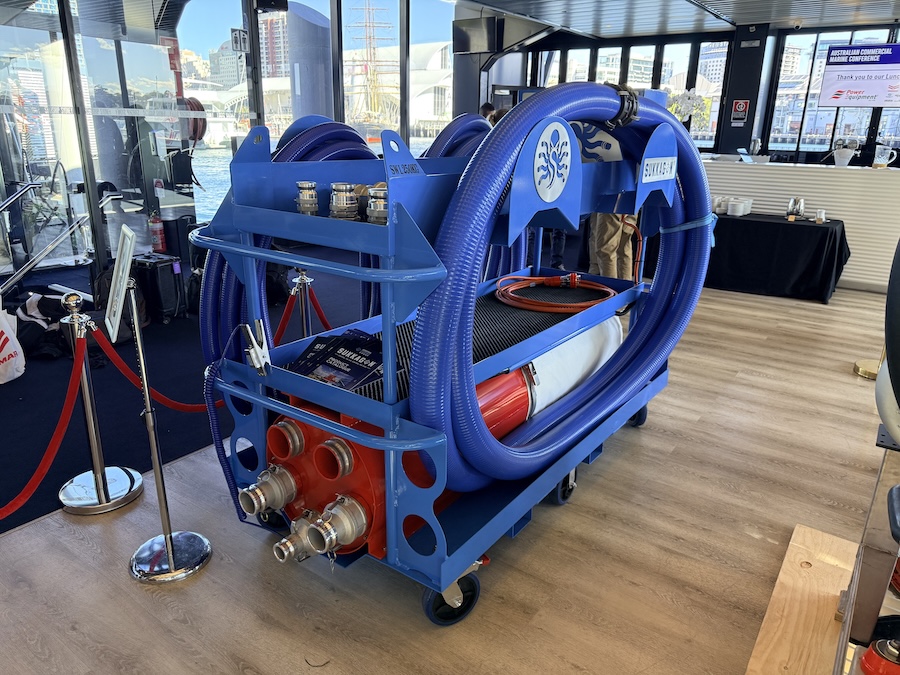
- Director Adam SpinelliSUKKAGON connects directly to a vessel’s existing tank and void ventilation piping using flexible hoses and purpose-designed couplings. It combines the vessel’s engineered ventilation network with its own high-performance extraction capability, allowing contaminated atmospheres to be removed at the source in a process the company compares with an industrial vacuum system.
The equipment remains outside the confined space and can deliver either positive or negative ventilation. It can be configured to support one space or several tanks simultaneously, potentially reducing the number of separate fans and ducting arrangements required across a vessel.
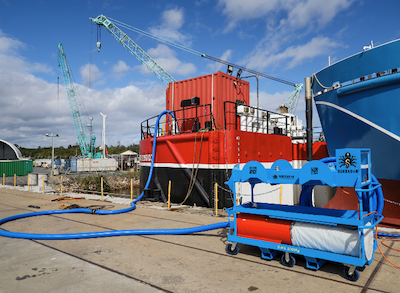
That external configuration is one of the system’s most practical features. Hoses attach directly to tank and void vents, removing the need to run bulky ducts through corridors, across working decks or through watertight doors. Barrel fans are also kept away from entry points, where they can restrict visibility, impede the movement of workers and equipment, and add considerable noise to an already demanding work environment.
Director Clayton “Ditch” Vladich said the system’s focus on the people undertaking vessel maintenance had been recognised by shipyard operators, safety professionals and maritime decision-makers.
“The SUKKAGON was one of the few solutions built to improve how people work on them,” Vladich said following the company’s participation at the Australian Commercial Marine Conference.
Vladich said the product attracted interest from commercial shipyard owners and operators, senior executives, safety and compliance leaders, and Defence and naval decision-makers. He said that response demonstrated international recognition of an Australian-developed system focused not simply on improving a vessel, but on improving conditions for the personnel maintaining it.
The system is also intended to deliver substantial productivity benefits. Faster and more standardised deployment can reduce the time required to establish ventilation before maintenance begins, allowing work to commence sooner and helping to minimise project delays.
Controlled extraction can improve visibility during welding, gas cutting, grinding, sandblasting and painting. Removing smoke, fumes and airborne particulates at their source can also help prevent contaminants from spreading into adjacent areas and disrupting other maintenance activities taking place aboard the vessel.
Reducing reliance on multiple portable fans can lower workplace noise and support clearer communication, coordination and situational awareness. Clearer access routes can improve the movement of personnel, tools and equipment, while the ability to ventilate several tanks from one unit can increase equipment utilisation and provide greater flexibility across a maintenance program.
General Manager Johnny Fisher said the value of SUKKAGON extended beyond simply moving air through a confined space.
“The benefit begins with a faster and more orderly setup, continues through improved access and visibility, and extends to better coordination between the different teams working aboard the vessel,” Fisher said.
“When ventilation can be deployed consistently and contaminants are controlled at the source, supervisors have greater confidence in the work environment and personnel can focus on completing the task safely, efficiently and to the required standard.”
SUKKAGON measures 2300mm long, 1000mm wide and 1700mm high and weighs 250kg unladen. Its listed features include a variable-speed controller, an IECEx flameproof and dustproof motor, rated lifting points, solid lockable wheels and a 32-amp three-phase power supply with a 10-metre lead.
Adaptable hose sizes range from 1.5 to four inches, with tailored configurations available to meet particular requirements. Washable and interchangeable particulate filters are incorporated to capture contaminants, while the complete unit can be positioned on different decks during maintenance or at sea.
The company says SUKKAGON has been developed with contemporary workplace health and safety practices in mind and to align with ISO 45001 safety-management principles. Its objective is to provide controlled, consistent and measurable airflow while eliminating many of the inefficiencies associated with conventional ventilation methods.
SUKKAGON is available through an annual lease, a three-year lease-to-own arrangement or outright capital purchase. Lease options include operational use of the system, standard servicing and inspection, guidance on integration into confined-space procedures and technical support. Pricing is available on application.
For shipyards, Defence sustainment providers, commercial operators and large-vessel refit organisations, SUKKAGON offers a different approach to a familiar challenge. Rather than treating ventilation as a temporary supporting measure, it positions atmospheric control as a managed part of the maintenance process, supported by purpose-designed equipment, repeatable deployment and clearly defined operational outcomes.
Read the Marine Business News review hereFor further information, visit their website HERE
To learn more about SUKKAGON and to download a full product catalogue visit their website HERE
This product overview is based on information supplied by Control Point Group. SUKKAGON has not been independently performance-tested by Marine Business News. Organisations are encouraged to make their own enquiries to determine whether the product is suitable for their business needs.