By Commander David Jordan CSC RAN (Rtd)
STS Young Endeavour has been in Service with Royal Australian Navy (RAN) since 1988. The Sail Training Ship undertakes about 20 experiential development voyages per annum. Each voyage usually lasts 11 days with up to 24 young Australians between the ages of 16 to 23 embarked. While the Ship is managed by the RAN, the Young Endeavour Youth Scheme coordinates the voyage program. At the ripe old age of 38 it’s no surprise that the Navy sought a replacement.
In the December 2023 edition of the renowned Naval Historical Review, an article titled “Young Endeavour Replacement” outlined the initial stages of the Young Endeavour Replacement efforts with Defence signing a contract with Birdon in March 2022 for the design and construction of the Ship under Project SEA 1788. Established in 1977, Birdon is a 100% Australian-owned, global engineering and services partner operating across Australia, the United States, Europe and Asia. Construction of STS Young Endeavour (II) is well and truly underway at Birdon’s facility in Port Macquarie, NSW. Penned by the esteemed Dutch design studio, Dykstra Naval Architects, the state-of-the-art barquentine has been registered as an Australian Ship with the IMO identification number 1025320. Young Endeavour II was laid down on 25 July 2023 and the Ship’s hull rolled over on 17 December 2024.
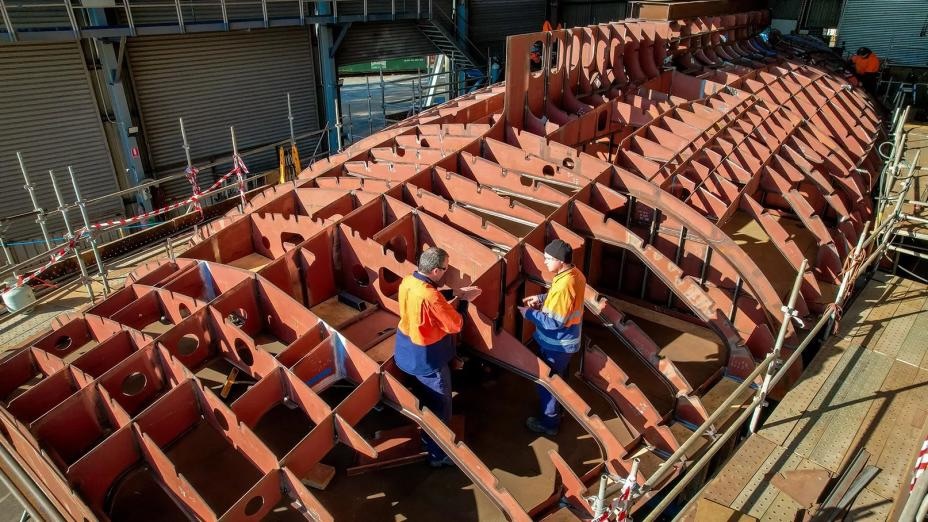
Initial work on the upturned hull of Young Endeavour (II) at the Birdon facility
The masts are stepped
In another mark of her build progress, the three masts were stepped in June 2026 with a coin placing ceremony taking place on 7 August 2024. Placing a coin during mast stepping is a 2,000-year-old maritime tradition. In modern times the practice of placing a coin generally serves as a symbolic gesture for good luck to ensure fair winds and following seas. Very apt for a square-rigged tall ship. One uncirculated Australian $1 coin was placed obverse (head side) up at the base of the foremast featuring the effigy of King Charles III, the reigning monarch and its year of minting, 2026. Another $1 coin was placed at the base of the mizzen mast crest up. Perhaps seeking even more luck, two coins were placed at the base of the main mast; a Young Endeavour (II) challenge coin, crest side up and a 1988 Australian Bicentennial commemorative coin.
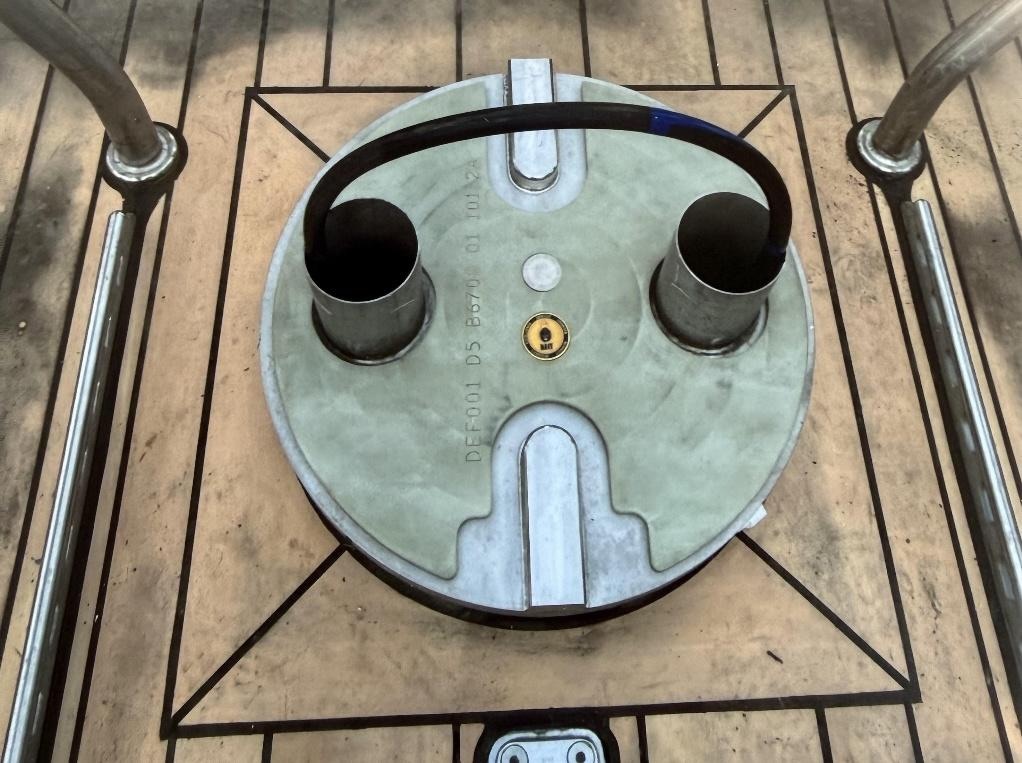
The coins placed at the base of the main mast
A tour of the Ship
The Author, previously a Voyage Captain in STS Young Endeavour (I), represented the Naval Historical Society at the coin placing ceremony and had an opportunity to tour the new Ship:
The waters of the Hastings River shimmered off the royal blue hull as the bright sunshine of a glorious winter’s day called for sunglasses and a hat. The stainless-steel fittings were gleaming and the standing rigging sparkling. The three recently stepped masts stood tall over Young Endeavour (II). The immediate thought is that the Ship is bigger but its lines give a familiar and comforting feel. All the hallmarks of a successful sail training ship layout were there to be observed.
The main doghouse amidships is large to allow the Youth Crew an area to transition in to or out of their foul weather gear instead of having to do that down below near the accommodation spaces where others might be sleeping. The main café is huge. It should be a good space to do whole-ship activities when the weather precludes using the upper deck. Likewise, the chart house is large and seems much more conducive to learning than the arrangement in Young Endeavour (I). There isn’t access onto the bowsprit but plenty of room on the forecastle to dolphin watch. Aft there are two large RHIBs and a crane to service them. The Staff Crew mess seems a little small but the berthing arrangements are fantastic. Likewise for the Youth Crew.
Sail handling set up appears logical and has been designed for, well, sail training. It’s always a challenge in a Ship like this to get the main traveller wide enough to allow optimum sail performance. But it’s about sail training, not yacht racing. Indeed, the running rigging, while featuring modern high-quality fittings, still uses traditional securing arrangements. Fantastic for the Youth Crew experience. There is no reason to doubt She will sail well. It’s a large sail plan but to an old man of the sea who has sailed a few miles, it should work well.
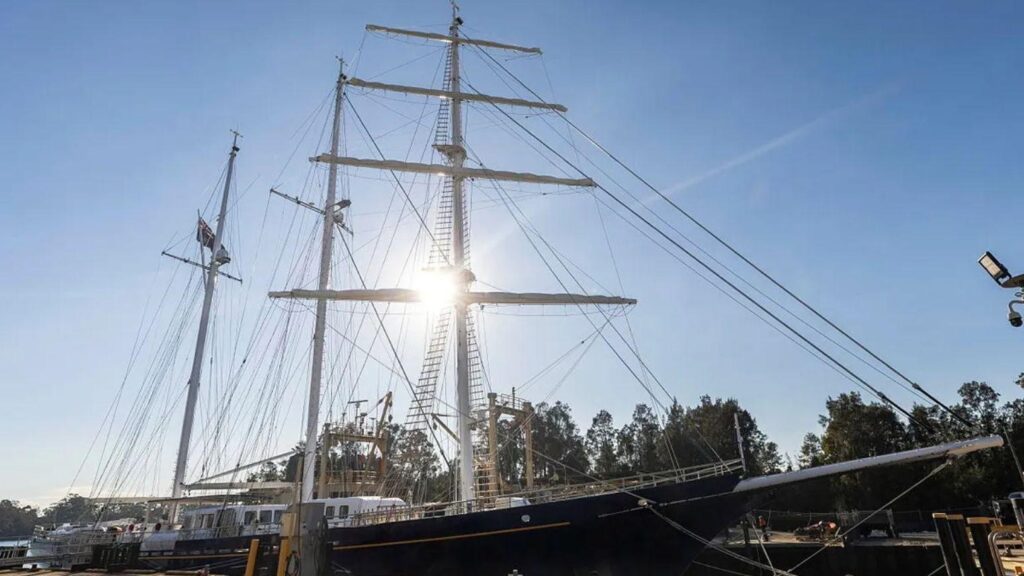
Young Endeavour (II) with masts stepped alongside the Birdon Group facility
Comparing the Pair
A quick data check will allow for brief comparison of the two Ships.
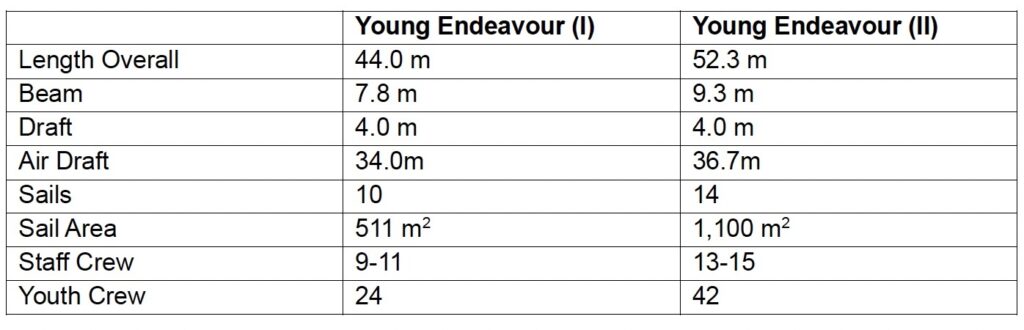
On a length and beam ‘size’ basis, the new Ship is about 18 per cent bigger. But the interior volume is so much more, allowing for improved layouts in areas such as the galley. Importantly, it allows for more Youth Crew, which means more young Australians should be able to participate in the program. The 11-day voyage construct will likely remain the same. Given maintenance requirements, it is difficult to see there being more voyages on offer but there will be more Youth Crew on each of the voyages.
The Staff Crew size has increased, primarily from the need to add a second chef and another watch leader. But the whole Staff Crew pool is only about 18 personnel, with individuals rotating between voyages to allow for leave and naval training requirements. The Staff Crew probably do more sea time per year than any other Ship in the RAN.
Back to the size of the new Ship and one data point that stands out is the draft, which is exactly the same as the current Ship. This is important from the perspective of access to ports and anchorages, which is a critical factor for successful delivery of the program.
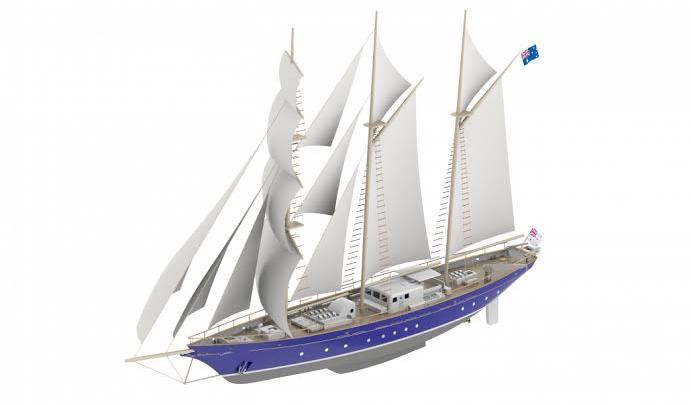
Outline schematic of Young Endeavour (II) showing the sail plan
However, the larger size of Young Endeavour (II) may restrict some of the current berthing options used in many of the smaller ports.
Despite being only 18 per cent ‘bigger’, Young Endeavour (II) carries double the sail area. The main gaff is also not fixed so will need to be set when using the main or main gaff topsail. The mizzen seems to be a ‘set and forget’ arrangement, which will help overall sail handling. But a bigger sail plan doesn’t necessarily mean busier. Indeed, the Ship sits well and the deck area in particular, appears very spacious and conducive to working the sails and rigging.
A continuation
Young Endeavour (II) has sometimes been referred to as the new Ship. But really, it is a continuation of the Young Endeavour Youth Scheme. A continuation of nearly four decades of RAN involvement in providing a platform for the development of the youth of Australia. It is something the RAN should be very proud of.
Continuing the tour of Young Endeavour (II) and workers further informed of progress. For example, the fuel system had just been commissioned and ‘light off’ of the diesel generators was due to occur in mid-August. Other systems and equipment were also due to be set to work in late 2026. During the tour, the Author had opportunity to talk with some of the Tests and Trials team who were busy completing the Test Master Plan and putting together the schedule. Trials might begin as early as the end of 2026 with Young Endeavour (II) scheduled to be commissioned sometime in early 2027. Voyages will likely commence mid-2027.
Sources, Resources and Acknowledgements
I wish to acknowledge the support of the Young Endeavour Replacement project, in particular Mr Stephen Moss CSC who serves as the on-site Project Management Representative for the RAN’s Project SEA 1788, managing the acquisition and build of Young Endeavour (II). Stephen was also a long-standing former Executive Director of the Young Endeavour Youth Scheme. It was great to reconnect with the current Commanding Officer of Young Endeavour (I), Lieutenant Commander Adam Farley RAN and Voyage Captain Commander Gavin Dawe OAM RAN. Birdon hosted a fantastic ceremony and were extremely generous in their support.
Acknowledgement of Imagery:
Pic 1 – Birdon Group
Pic 2 – Birdon Group
Pic 3 – Department of Defence RAN at LinkedIn
Pic 4 – Birdon Group via Dykstra Naval Architects
About the Author:
David Jordan spent his childhood in Papua New Guinea and the Pacific before joining the RANC in 1983. After the usual training as a Seaman Officer, he qualified as an Officer of the Watch and subsequently as a warfare officer specialising in Gunnery. He commanded the patrol boat HMAS Bendigo (II) and the frigate HMAS Warramunga (II). He also served as Voyage Captain in STS Young Endeavour. He left the Permanent Naval Force in 2007 and transferred to the Reserves. David has undertaken numerous roles in defence industry and is currently a consultant advising small and medium enterprises. When time allows, he enjoys naval history, researching and writing about small ships, particularly through lived experiences.
Published with the kind permission of the Naval Historical Society of Australia – to learn more about their work, visit their website HERE